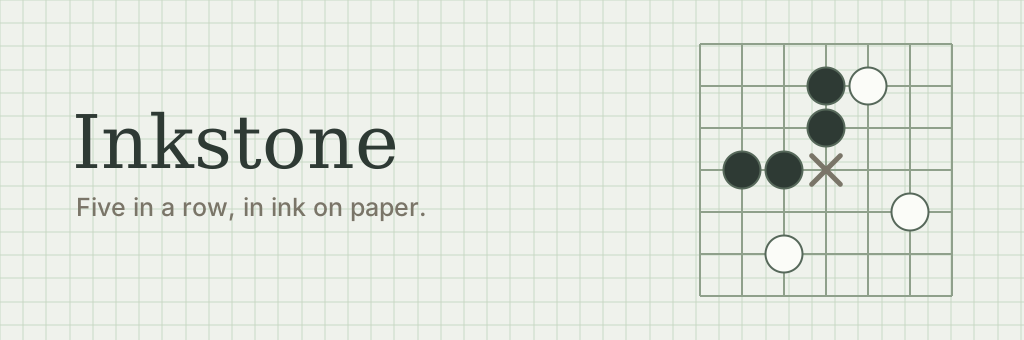
Inkstone is five in a row, drawn on a sheet of paper. Black and white take turns setting a stone on a crossing, and the first colour with five of its own in a line — across, down, or corner to corner — wins. That is the game everybody already knows. The work went into playing its four rule sets exactly as they are written, and into showing you what they mean while you play.
Every point black may not play is marked before you play it
Plain five-in-a-row favours whoever goes first, and every serious version of the game answers that in its own way. Renju's answer is that black needs exactly five and may not make a double three, a double four or a row of six. Those three shapes end the game on the spot — so every crossing that would make one is crossed out on your board, in pencil, before your stone lands. You see it coming and play somewhere else.
The stone is never taken out of your hand. Lift your finger on a crossed-out point and the board tells you which rule it is; ask a second time and it plays it, and the game ends the way the rules say it ends.
Features
- Four rule sets, each said in one line where you choose it. Free-style: five or more wins, for either colour. Standard: exactly five wins. Renju: black is restricted, and the restrictions are marked. Swap2: one player sets out three stones and the other picks a colour, or raises.
- Three cards on the first launch — the game played out on a small board, the terms of your first game, and the three forbidden shapes drawn on boards of their own. They are in Settings whenever you want them again.
- Drag a stone to the crossing you want and lift your finger to set it down. Nothing is committed until you let go.
- Boards at 9×9, 13×13 and 15×15, each one drawn to fit the screen it is on.
- Three levels of computer opponent, or hand the phone across the table. Choose the colour you play, or take turns with it.
- Five surfaces to play on — graph paper, a napkin, a wooden board, a slate slab and a blueprint — and five sets of stones, each with its own mark cut into it.
- Send a finished board to anyone, as a picture.
- Games finished, kept by rule set and by opponent, with your longest run of wins. Write the record to a file you keep, and read it back.
- Works offline, on a plane, in a tunnel. Everything it remembers stays on the phone.
- Nine languages, picked in Settings.
Open it and play
Every board size, every rule set and every opponent is yours the first time you open it.